
 My Account

 Login


To get Texas food manager certification, you pass a food manager exam that the Texas Department of State Health Services (DSHS) approves or that carries ANSI certification. Per DSHS, you can take that exam through any licensed program, test site, national program or internet exam provider. The certificate lasts five years. Most permitted food establishments that handle exposed time/temperature control foods need one certified manager on staff. This guide covers who needs it, how the process works, what changes in Florida and Ohio, and how food manager rules differ from alcohol server rules.
TL;DR
- Texas requires one certified food manager at each permitted food establishment, with exemptions for things like prepackaged-only operations and child care facilities.
- You earn the certificate by passing a DSHS-approved or ANSI-certified exam. DSHS does not run the exams or issue certificates itself.
- Certification is valid for five years. It cannot be renewed, so you re-test.
- Florida, Ohio and Michigan each have their own rules, and alcohol server training is a separate credential from food manager certification.
- We offer a Food Manager’s Certification with online or in-person proctored exam options, plus alcohol server and food handler courses, on one platform.
Table of Contents
- Who needs a certified food manager in Texas
- How to get certified, step by step
- How long it lasts and how to renew
- How to choose a program
- Food manager rules in other states
- Alcohol server training is a different requirement
- Get certified with us
- Our perspective
- Keeping a team compliant
- FAQ
- Sources
Who needs a certified food manager in Texas
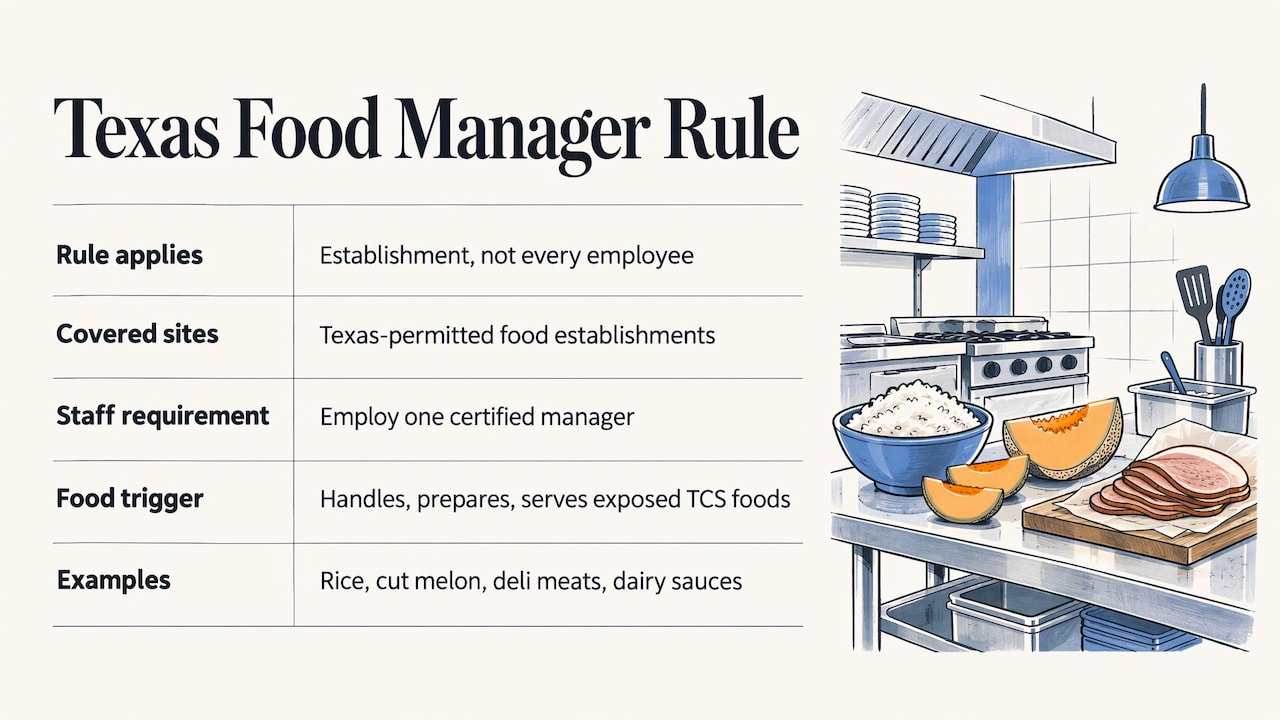
The rule applies to the establishment, not to every employee. Under 25 Texas Administrative Code §229.177(b), each food establishment permitted under Texas Health and Safety Code §437.0055 must employ one certified food manager. DSHS’s FAQ ties this to establishments that handle, prepare or serve exposed TCS foods, citing Health and Safety Code §437.0076 and the Texas Food Establishment Rules.
TCS stands for time/temperature control for safety. Think cooked rice, cut melon, sliced deli meats, dairy-based sauces and similar foods that need temperature control to stay safe. If your kitchen cooks or portions these items, assume the rule covers you.
Who is exempt
Section §229.177© lists the exemptions. According to the same rule text, these are not required to have a certified manager:
- Establishments that handle only prepackaged food
- Child care facilities
- Establishments that do not prepare or handle exposed TCS food
- Nonprofit organizations as defined in §229.371(9)
If you are unsure which side of the line you fall on, ask your local health department, which is the office that issues and inspects your permit.
Food manager vs. food handler
These are two different credentials. A food handler card covers basic safe practices for line cooks, servers and dishwashers. A food manager certificate is the higher-level credential for the person responsible for the operation’s food safety systems. Many Texas operators end up needing both: the manager certificate for the person in charge, and food handler training for the rest of the team. Our Food Handler’s Permit course is $13.99 and is self-paced on any device.
How to get certified, step by step
- Confirm you need it. Check the exemptions above and your permit type with your local health department.
- Pick an exam type that Texas accepts. DSHS states that CFM certificates from ANSI-CFP providers carry national reciprocity, while those from DSHS-licensed providers carry state reciprocity. That distinction matters if you plan to work in more than one state.
- Prepare. Training is a good way to get ready, and many people take a course before the exam. It helps to cover cross-contamination, temperature control, cleaning and sanitizing, HACCP basics and allergens. Texas exams must test food allergen awareness, according to 25 TAC §229.176.
- Sit the proctored exam. Proctored means someone verifies your identity and supervises the test, either in person or through an online proctor.
- Keep your certificate on file. Inspectors can ask for it, so keep a copy at the establishment and a digital copy somewhere safe.
Where not to send money
One point trips up many first-timers. DSHS says it does not administer CFM training or exams and does not provide CFM certificates. Its guidance tells individuals not to apply or send money to DSHS to register for training or an exam. You contact the exam provider or training program directly. If a site implies you register with the state, back out.
How long it lasts and how to renew
A Texas CFM certificate is valid for five years, per DSHS. The city of Rosenberg, for example, spells out the practical consequence: certificates are not renewable, so to recertify you pass a DSHS-approved exam again. Put the expiration date in your calendar about six months ahead so a lapse never overlaps with an inspection.
What about the fees DSHS lists?
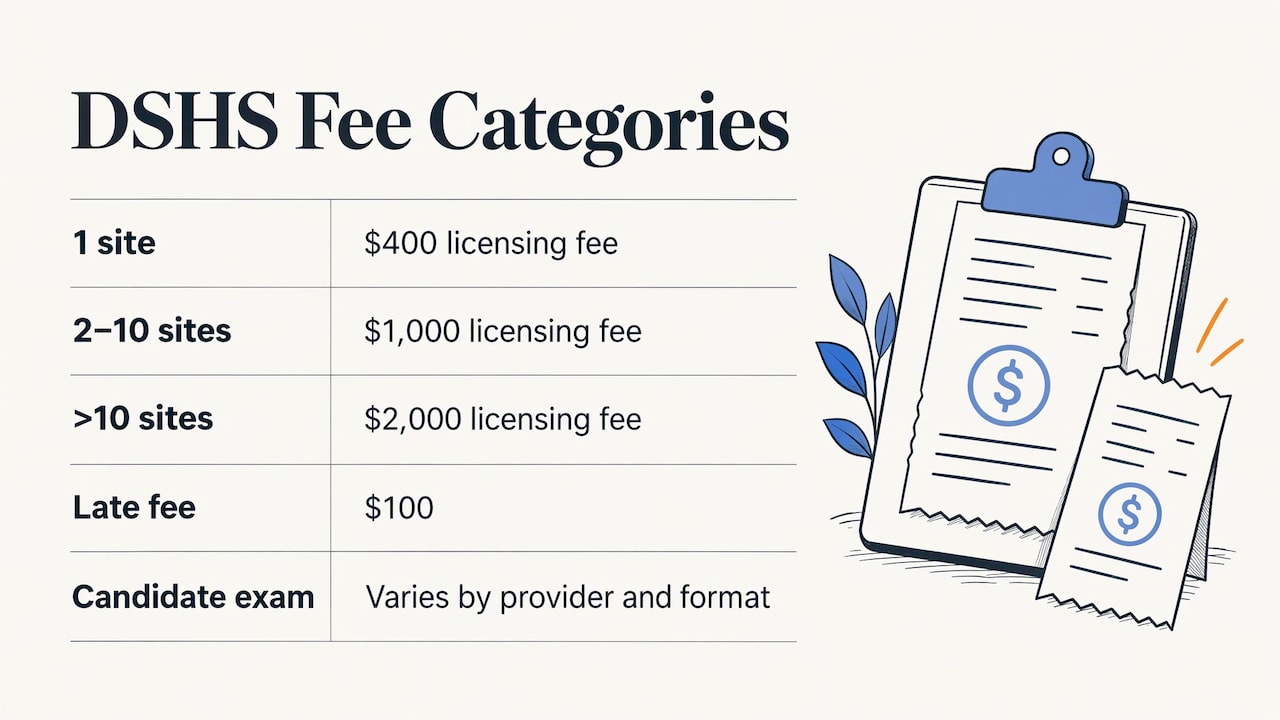
DSHS publishes fees on its Food Manager Licensing page: $400.00 for one testing site, $1,000.00 for 2 to 10 sites, $2,000.00 for more than 10, and a $100.00 late fee. Those are licensing fees for organizations that run testing sites. They are not what a candidate pays. Your cost is the exam provider’s price, which varies by provider and format, so compare the total including the exam, any proctoring and any study material.
How to choose a program
The market is crowded, so a few criteria help:
- Accreditation fits your plans. If you may move or manage in several states, a nationally recognized (ANSI-certified) exam gives you the widest reciprocity.
- Proctoring format. Online proctoring suits people with a webcam and a quiet room. In-person proctoring suits those who prefer a test center or have unreliable internet.
- Self-paced prep. Shift workers need training they can pause and resume on a phone or laptop.
- Team options. If you certify several managers across locations, look for group management and consolidated records.
- Clear total price. Know what is included before checkout.
Our Food Manager’s Certification is offered with an online proctored exam and an in-person proctored exam. See the courses page for current details and pricing.
Food manager rules in other states
Readers searching for Texas often also look at neighboring and large states. Here is how a few compare, from official pages.
Florida
The Florida Department of Health says a certified food manager has passed a written exam approved by ANAB, and the certificate is valid five years from issuance, after which you test again. The department does not require a preparation course, though approved test providers offer them. On timing, the state’s licensing agency says managers must complete training and pass the exam within 30 days of employment, and establishments must show proof of certification on request, including at inspection.
Ohio
The Ohio Department of Health says risk level three and four food service operations and retail food establishments need at least one person with authority to direct food activities who holds an Ohio manager certification in food protection. That person need not be on site at all times but must work primarily in the facility. To qualify, you complete an ODH-approved manager course and pass an approved exam, and the course completion date must fall within one year of the exam date.
Pennsylvania and elsewhere
Food manager rules vary by state and sometimes by county or city. For Pennsylvania or any state not covered here, start with the state agriculture or health department and your local health office, and confirm which exams they accept before you buy a course.
Alcohol server training is a different requirement
A restaurant manager in Texas often needs two things: food manager certification for the kitchen and alcohol server training for the bar and floor. They come from different regulators and follow different rules. If you also serve alcohol in Texas, our Texas Alcohol Seller Server Training + Texas Food Handlers bundle pairs both. For the legal background, read our guide to alcohol service requirements in Texas.
Ohio alcohol server training
The Ohio Investigative Unit runs the Alcohol Server Knowledge (ASK) program for people who sell and handle alcohol, covering the rules for Ohio liquor permits. On age, the state Division of Liquor Control, as reported by NABCA in August 2025, sets 19 as the minimum to serve beer at on-premises outlets and 18 to sell beer for carryout. Our Ohio Server Training + Food Handler Courses bundle covers servers who need both.
Michigan alcohol server training
Michigan puts the duty on the licensee. Per the Michigan Liquor Control Commission, on-premises licensees must give proof of an approved server training program within 180 days of being issued a license or transferring 50% or more interest in one. At a minimum, server-trained supervisory personnel must be employed during all hours alcohol is served. The statute, MCL 436.1501(1), allows the commission to waive the requirement based on responsible operating experience or training. Under MCL 436.1707(7), a 17-year-old who has completed server training can sell or serve if an on-site supervisor aged 18 or older is present.
Side-by-side summary
| Topic | Texas | Florida | Ohio | Michigan |
|---|---|---|---|---|
| Credential | Certified food manager | Certified food manager | Ohio manager certification in food protection | Server training for on-premises licensees |
| Who must hold it | One per permitted establishment, with exemptions | Managers, within 30 days of employment | At least one person in charge at risk level 3 and 4 operations | Supervisory personnel during all serving hours |
| Exam basis | DSHS-approved or ANSI-certified | ANAB-approved | ODH-approved course and exam | Approved server training program |
| Validity | 5 years | 5 years | Course within 1 year of exam | See the LCC page |
Get certified with us
We built our platform for people who work shifts and cannot sit in a classroom. Courses are self-paced and run on any device, so you can study on a break and pick up where you left off. If you manage a kitchen, our Food Manager’s Certification is available with an online proctored exam or an in-person proctored exam. For the rest of the team, food handler training starts at $13.99, and state-specific alcohol server training starts from $9.99.
We also manage group training for restaurants and bars, so owners can assign courses and keep track of who has finished.

Start on the Food Manager’s Certification page, or browse everything in our shop. For team packages, visit ABC Server Training.
Our perspective
Most of the confusion we hear from restaurant owners comes from treating every credential as one thing. A food manager certificate, a food handler card and an alcohol server permit answer to different rules, and a manager often needs all three.
Our approach is to make each one easy to finish. We design our training to be user-friendly, to work on any device and to let people go at their own pace, because the people who need certification are usually busy working. With over 100,000 learners trained, we have seen that a clear course and a simple checkout are what get a team compliant before the inspector arrives.
If you run a kitchen and a bar, we suggest sorting your team into three groups: the person in charge who needs the manager certificate, the staff who handle food, and the staff who pour alcohol. Then buy the right course for each group, and track expirations in one place. That is what our group and corporate options are built for.
the author
Keeping a team compliant
Once the manager is certified, the work shifts to upkeep. A few habits help:
- Keep a roster with each person’s credential and expiration date.
- Remember that Texas manager certificates cannot be renewed, so schedule the retest early.
- Train new hires in their first days, not their first months. Our piece on reducing turnover through server training explains how early training also helps retention.
- If you operate in several states, review each state’s rules, since one certificate does not always carry over. Our state requirements guide is a good starting point for alcohol service.
FAQ
Does Texas require every restaurant to have a certified food manager?
Most permitted establishments that handle exposed TCS food do. The rule requires one certified food manager per permitted establishment, with exemptions for prepackaged-only operations, child care facilities, establishments without exposed TCS food, and certain nonprofits. Confirm your status with your local health department.
How long is a Texas food manager certificate valid?
Five years. Texas certificates cannot be renewed, so you pass an approved exam again to get a new one. Plan the retest before your expiration date so you stay covered during inspections.
Do I register with DSHS to take the exam?
No. DSHS does not run CFM training or exams and does not issue certificates. You go directly to an exam provider or training program, and you should not send money to DSHS for registration.
Is a Florida or Ohio certificate the same as a Texas one?
Not automatically. Each state sets its own rules, and Ohio, for example, has its own manager certification process. Certificates from ANSI-accredited providers carry national reciprocity in Texas, but always confirm acceptance with the regulator where you will work.
Is alcohol server training part of food manager certification?
No. They are separate credentials from separate regulators. If your staff serve alcohol, they need the alcohol server training your state or employer requires in addition to any food safety certificate.
Sources
- Texas DSHS: Certified Food Manager FAQ
- Texas DSHS: Licensing of Certified Food Manager Training Programs
- Texas DSHS: Food Manager Licensing
- 25 Tex. Admin. Code §229.177
- 25 Tex. Admin. Code §229.176
- Florida Department of Health: Food Manager Certification
- Florida DBPR: Food Service Manager Certification
- Ohio Department of Health: Food Safety Certification
- Ohio Investigative Unit
- NABCA: Ohio report, August 2025
- Michigan LCC: Server Training Requirements
- MCL 436.1501
- MCL 436.1707