
 My Account

 Login


A workplace violence prevention course teaches employees to spot warning signs, defuse tense situations, report incidents and respond safely. No federal rule requires every employer to run one. California does require it, as does New York for retail employers. Everywhere else, OSHA expects employers to protect workers from known hazards, and training is one of the most common ways to do that. You can finish most courses online in about an hour.
This guide covers what the training includes, who needs it, how often to repeat it, what a completion certificate does and doesn’t mean, and how restaurant and bar teams can handle it.
TL;DR
- There is no single federal workplace violence training standard. OSHA relies on the General Duty Clause, so employers must still address recognized hazards.
- California requires covered employers to have a written prevention plan and to train employees on it, at the start and every year after.
- New York requires retail employers with 10 or more employees to train staff at hire. Restaurants that mostly sell food to eat on site are exempt from that retail law.
- Online delivery is accepted in New York’s program guidance. Keep a record of who completed the course and when.
- We offer a California Workplace Violence Prevention course for $34.99.
Table of Contents
- What a workplace violence prevention course covers
- What the law requires, state by state
- How often training has to be repeated
- Is there a workplace violence prevention certification?
- Taking the course online
- Workplace violence training for restaurant and bar staff
- Perspective
- Choosing and starting a course
- FAQ
- Sources
What a workplace violence prevention course covers
Good courses follow the same logic OSHA describes for any prevention program. OSHA says workers should know the employer’s policy, be trained on prevention methods, signs of potential violent behavior and how to react when an incident occurs, and understand that every claim will be investigated and resolved promptly.
In practice, a course breaks down into these parts:
- What counts as workplace violence. Physical assault, threats, intimidation, harassment and aggression from coworkers, customers, visitors or people from outside the business.
- Warning signs. Behaviors of concern, such as escalating anger, threats, or fixation on a coworker.
- De-escalation. Staying calm, using a low tone, giving space, and knowing when to step back and get help.
- Reporting. Who to tell, how to document an incident, and why a report is never held against the person who makes it.
- Emergency response. Alarms, exits, calling 911, and what to do during an active threat.
- Your workplace’s own plan. Hazards specific to your site, such as late-night closing, cash handling or an unlit parking lot.
The courses that rank for this topic reflect that spread. Some are short, self-paced and online, others are full-day classes aimed at safety managers, and some are built for healthcare. A short online course suits most hourly staff. A longer class suits the people who write the plan and lead the response.
Who should take it
Anyone who deals with the public, works alone or late, or handles cash is a good candidate. That includes servers, bartenders, hosts, bouncers, cashiers, delivery drivers and managers. Supervisors benefit most because they receive reports and decide what happens next.
What the law requires, state by state
Requirements depend on where you operate and on your industry. Here is what is checked and current.
Federal: the General Duty Clause
OSHA states that it has no specific standard for workplace violence. Employers still owe workers a workplace free from recognized hazards likely to cause death or serious physical harm under the General Duty Clause. OSHA also says that an employer who has experienced violence, or who learns of threats or intimidation, should put a prevention program in place that combines engineering controls, administrative controls and training.
Law firm Fisher Phillips notes that even without a federal standard, employers keep their General Duty obligations. Enforcement requires OSHA to show the employer knew or should have known of a serious risk and failed to act. The practical lesson is that a documented training program is the simplest evidence that you took the risk seriously.
California: SB 553
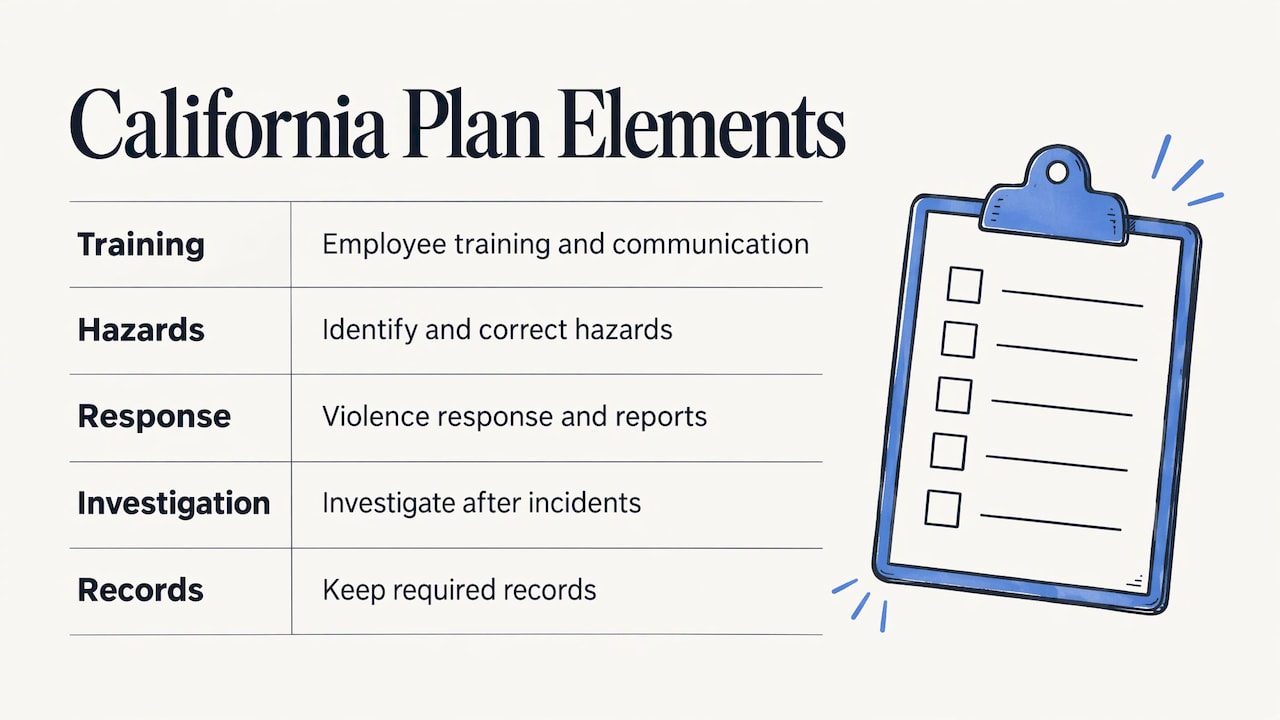
California is the strictest state for most employers. SB 553 was signed on September 30, 2023. Under Labor Code section 6401.9, covered employers must establish, implement and maintain a written Workplace Violence Prevention Plan. Enforcement began July 1, 2024. Cal/OSHA says the plan must include employee training and communication, hazard identification and correction, response to violence and reports, post-incident investigation, and recordkeeping.
The California Restaurant Association confirms that the law applies to restaurants, requiring both a plan and employee training. It also advises keeping records of hazard management, training, incident handling and investigations.
If you run a California bar or restaurant, our guide on California’s beverage service requirements covers the alcohol side of your compliance. Training for violence prevention is a separate obligation.
New York: retail workers
New York’s Retail Worker Safety Act applies to retail employers with 10 or more employees. The state Department of Labor says those employers must give all employees interactive retail workplace violence prevention training upon hire. Restaurants and other food businesses that mostly sell food to be eaten on site are exempt from the retail law, according to Gothamist’s coverage.
Louisiana: bartenders and counter staff
Louisiana’s Behind the Counter Protection Act (HB 1238), effective August 1, 2026, covers workers at service counters, drive-through windows and similar customer-facing posts, including bartenders and certain food servers. According to Fisher Phillips, it imposes no obligations on employers. It allows workplace postings and sets enhanced criminal penalties for offenders. It is not a training mandate.
Quick comparison
| Jurisdiction | Training required? | Who is covered | Frequency |
|---|---|---|---|
| Federal (OSHA) | No specific standard; General Duty Clause applies | All employers | No fixed schedule |
| California | Yes, as part of the written plan | Covered employers, including restaurants | At plan start, then annually |
| New York | Yes, retail workplace violence prevention training | Retail employers with 10+ employees; on-site food businesses exempt | At hire; yearly (50+ employees) or every two years (49 or fewer) |
| Louisiana | No employer obligation | Counter-based workers, including bartenders | Not applicable |
Other states have their own rules, some for specific industries such as healthcare. Check your state labor department’s page before you buy a course.
How often training has to be repeated
In California, the California Restaurant Association says employers must conduct an annual review of the plan and provide annual training on the law’s requirements, including the plan itself. Law firm Cooley adds that, based on Cal/OSHA guidance, training must also happen when a new hazard is identified or the plan changes.
In New York, retail employers with 50 or more employees must repeat training once a year. Those with 49 or fewer must do it every two years.
Where no law sets a schedule, an annual refresher is a sound habit. It also gives new hires a starting point and gives managers a regular moment to review incidents.
Is there a workplace violence prevention certification?
Most courses end with a certificate of completion. It documents that a named employee finished a given course on a given date. That is useful: under California’s plan rules, training records are part of what the employer is expected to keep. In California, the training must also fit your own plan, so the course is one piece of the requirement and your site-specific discussion is another.
What the certificate does not do is create a license. Unlike alcohol server permits, which many states issue or approve, workplace violence training generally does not lead to a government-issued credential. When you pick a course, match it to the state and industry rules that apply to your business.
Taking the course online
Online delivery is widely used. New York’s Department of Labor says its workplace violence prevention program can be provided entirely in digital form, provided every employee has access to it. For an employer, the benefits are practical:
- Staff finish on their own time, on a phone or laptop.
- Night and weekend crews are not left out.
- Completion dates are easy to track.
- New hires can start in their first week.
A self-paced format works well for restaurants, where scheduling everyone into one room is hard.
Workplace violence training for restaurant and bar staff
Restaurants and bars face a particular mix of risks: alcohol, late hours, cash, crowded rooms and customers who arrive upset. Most incidents begin as a disagreement over a bill, a wait, a refusal of service or a cut-off. That is why de-escalation carries so much weight for hospitality teams.
A strong program for a restaurant or bar combines three layers:
- Violence prevention training, so every employee knows the policy, the warning signs and the reporting steps.
- Responsible beverage service training, so servers know how to refuse service and manage intoxicated guests.
- Practical customer-handling skills, practiced in team meetings.
Our articles on handling difficult customers in bars and conflict resolution skills for servers cover the third layer. Staff who feel prepared are also more likely to stay. Our piece on reducing turnover through server training explains the link.
A simple rollout for an owner or manager
- Find out which state rules apply to your location and headcount.
- Write down your policy: zero tolerance for threats and violence, with a clear reporting channel and a promise of no retaliation.
- Walk the site and note hazards, such as dark entrances, blind spots, cash handling and closing routines.
- Assign the course to every employee, with managers first.
- Hold a short team meeting on your site’s specific hazards and exits.
- Save completion records in one place.
- Set a yearly reminder to retrain and review.
Perspective
We train servers, bartenders and restaurant owners, and the same pattern shows up again and again. Violence at work rarely arrives without warning. It begins with a tense exchange at the bar or a complaint at the table, and the people who handle it best are the ones who have rehearsed what to say and who to call.
That is why we build our courses to be simple to start and simple to finish. Self-paced, available on any device, and short enough for a staff member to complete between shifts. A training program only protects a team when everyone actually completes it, so we design for completion.
For a restaurant owner, we see violence prevention training as part of the same compliance habit as responsible beverage service. Both put clear expectations in front of staff and leave a record that the business took them seriously. We would rather a team learn de-escalation in an hour online than learn it for the first time in the middle of an incident.
the author
Choosing and starting a course
Before you buy, check these points:
- Does it match your state? California employers should look for California-specific content. Other states may only need a general course.
- Is it self-paced and device-friendly? That matters for shift workers.
- Does it suit your industry? Look for scenarios with customers, cash and closing.
- Can you keep a record? You want a dated completion record per employee.
- Can it scale to the team? Owners with many staff need group management.
Our workplace violence courses
We offer a Workplace Violence Prevention course for general use and a California Workplace Violence Prevention course priced at $34.99. A Spanish-language California version is available for Spanish-speaking staff. Both are self-paced and work on any device.

If you are training a whole crew, our group and corporate training options make it easier to manage assignments for your team in one place. We also offer food handler permits, food manager certification, sexual harassment training and state alcohol server courses, so one platform can cover the rest of your staff compliance.
FAQ
Is workplace violence prevention training required for restaurant employees?
It depends on the state. California requires covered employers, restaurants included, to have a written plan and to train employees on it. New York’s retail training law exempts food businesses that mostly serve food for on-site eating. Elsewhere, OSHA’s General Duty Clause applies, but it sets no specific training rule.
How often do employees need workplace violence training?
In California, training is given when the plan is established, then annually, and again when a new hazard is found or the plan changes. In New York’s retail rule, it is yearly for employers with 50 or more employees and every two years for smaller ones. If no rule applies, an annual refresher is a sensible schedule.
Can I complete a workplace violence prevention course online?
Yes. New York’s Department of Labor says its program can be delivered in digital form as long as all employees can access it. Online, self-paced courses are a common way for employers to train staff, and many take about an hour.
Does the course give me a certification?
You typically receive a certificate of completion showing you finished the training. It is a training record, not a government license. Employers should keep these records, since California’s plan rules include recordkeeping for training.
Sources
- OSHA: Workplace Violence overview
- OSHA: Workplace Violence enforcement
- Fisher Phillips via JD Supra: Workplace Violence Prevention Month
- Cal/OSHA: Workplace Violence Prevention for General Industry
- California Restaurant Association: Workplace Violence Prevention Plan
- Cooley: California releases workplace violence prevention guidance
- New York State Department of Labor: Retail Workplace Violence Prevention Training
- New York State Department of Labor: Workplace Violence Prevention FAQ
- Gothamist: NY retail worker safety law
- Fisher Phillips: Louisiana workplace violence protections